
God Is the Main Actor in History
January 22
Week Four — Waiting Is Trust
“Look! The Lord is about to destroy the earth and make it a vast wasteland. He devastates the surface of the earth and scatters the people.
Priests and laypeople, servants and masters, maids and mistresses, buyers and sellers, lenders and borrowers, bankers and debtors, none will be spared.
The earth will be completely emptied and looted. The Lord has spoken!” Isaiah 24:1-3 NLT
“He existed before anything else, and he holds all creation together.” Colossians 1:17 NLT
No one is exempt.
That truth can feel confronting, perhaps even unsettling, but it is necessary. Isaiah does not soften it. When God moves in history, everyone is affected. The powerful and the powerless. The secure and the anxious. The confident and the forgotten.
There is a kind of shock and awe in Isaiah’s words. And in the culture we live in, shock is often what captures attention. Loud voices. Dramatic claims. Urgent headlines. Forceful posturing.
But this is not how our God usually works.
Our God is not brash or performative. He is not coercive or impatient. And He does not force Himself upon humanity.
He is gentle. He is faithful. And He waits to be chosen. Have you noticed this truth?
Isaiah 24 reminds us, quietly but firmly, that God is still the main actor in history. He is not reactionary or scrambling. He is not responding late. He is sovereignly at work, even when the world feels unstable or unclear.
This week’s theme, Waiting Is Trust, flows naturally from that truth.
If God is truly the main actor, then waiting is not wasted time. It is not weakness. It is not passivity.
Waiting is an act of trust. And waiting is something every human understands.
Think about the things we wait for.
The couple who has waited years for a child, praying, hoping, enduring disappointment after disappointment.
The person or family carrying financial pressure, waiting for relief, for provision, for stability.
The family walking through the consequences of a decision that went wrong, waiting, day by day, month by month, for clarity, healing, or restoration.
Waiting is part of the human condition. Scripture does not abstract this. It dignifies it.
I think of Simeon in the temple. Year after year, faithfully showing up. Waiting. Trusting. Believing a promise he had not yet seen fulfilled. And then one ordinary day, he holds an infant in his arms and declares that he has seen salvation (see Luke 2:25–35).
We often hear that story and distance it from our own lives, but Simeon’s waiting was real. His hope was tested. His faith was lived out quietly, over time.
What are you waiting for?
What is the prayer you have carried for years? What hope has not yet been answered? What outcome feels delayed, or perhaps like Abraham and Sarah, impossible?
Some prayers are answered quickly. Some take years. And some may not be fulfilled even within our lifetime.
But this still remains true: God is faithful.
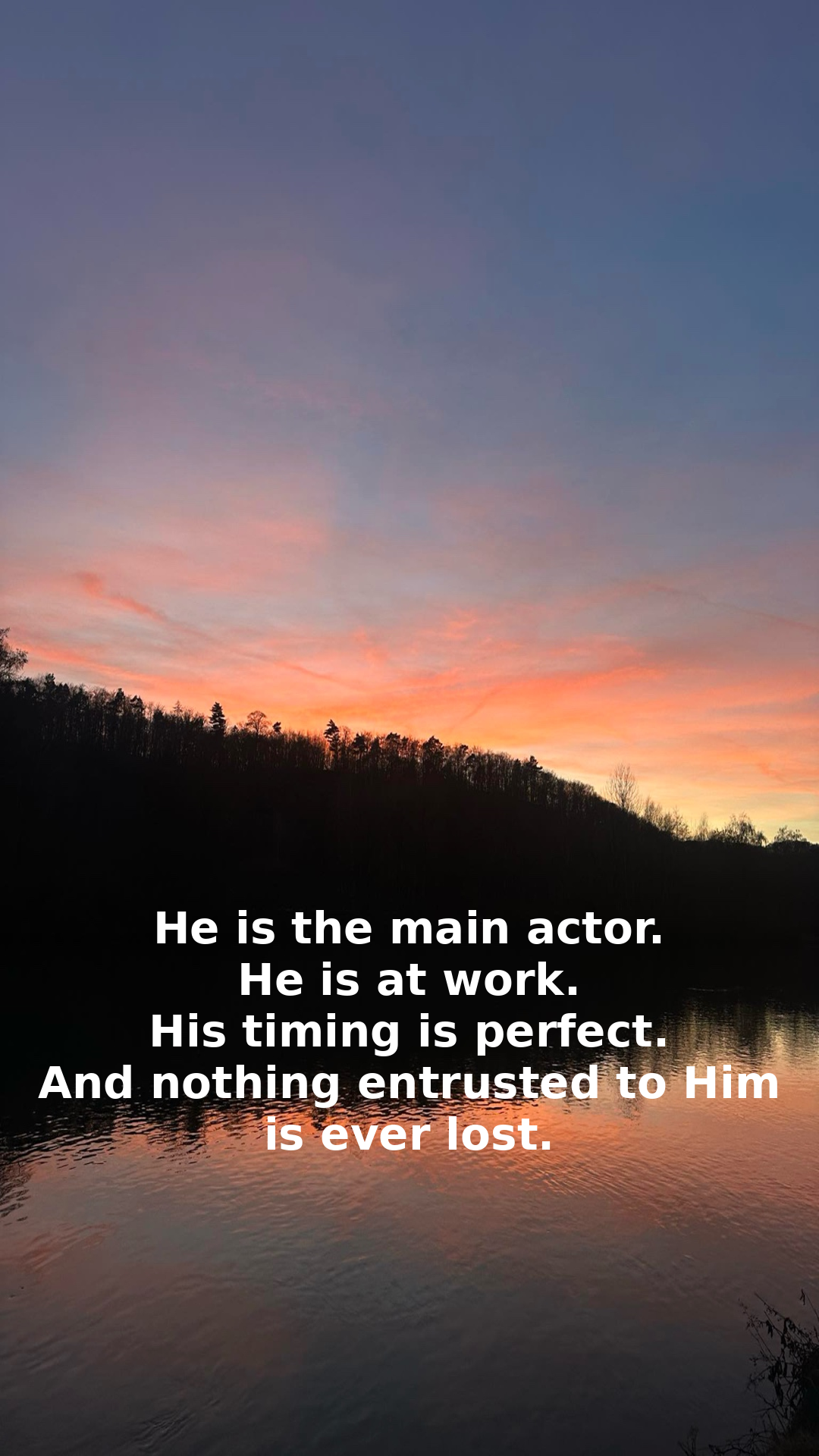
He is the main actor. He is at work. His timing is perfect. And nothing entrusted to Him is ever lost.
I remember being at sea during a storm, sailing back from Tonga. Violent, relentless and exhausting. It lasted only six hours, but every minute felt endless. Waiting for it to pass required trust. There was no control, only surrender.
More recently a project that should have been a year or so that ran for nearly four years and brought about all sorts of unexpected financial challenges and strain. Learning to wait and trust that in the midst of this was His purposes and timing. Albeit painful and deeply troubling.
Life is often like that.
Storms come. Fear rises. Strength runs out. And it is there, often at the end of ourselves, that we discover who God truly is.
Like Peter stepping out of the boat, keeping his eyes fixed on Jesus, something happens in us when we wait and trust. We are held. We are sustained. We do not sink, even when the waves are high (see Matthew 14:22–33).
It sounds beautiful when told as a story. It feels very different when it is lived out. But perhaps that is the point.
We come to the end of ourselves so that we might finally see Him clearly. We learn to wait so that we might learn to trust.
And in that waiting, God gives us peace, not because the storm ends immediately, but because He is present within it.
To wait on Him is not weakness. It is wisdom.
And He is worthy of our trust.
Practice for Today
Today, resist the urge to rush resolution.
Take a few quiet moments and name the thing you are waiting for:
• a decision
• a breakthrough
• healing
• provision
• clarity
• restoration
Hold it before God honestly. Then, instead of asking when, ask, “Lord, what does it look like to trust You with this today?”
Practice releasing control in one small, intentional way. Waiting is not doing nothing. Waiting is choosing trust.
Prayer
Father God, You are the main actor in history, and You are the main actor in my life.
I confess how easily I grow impatient. How quickly I want answers. How often I mistake waiting for weakness.
Today, I choose to trust You.
I bring before You the things I have been waiting for, the hopes I carry, the prayers that feel unanswered, the longings that have stretched my faith.
Teach me to wait well. Teach me to trust deeply. Give me peace in the waiting and courage in the uncertainty.
When I come to the end of myself, help me see that You are already there. Faithful, present and at work.
I place my life, my timing, and my future into Your hands. You are worthy of my trust. And I will wait on You.
In Jesus name I pray, Amen.